to like
Gustar is how Spanish says “to like.” The thing you like is the subject, and the person who likes it is the indirect object.
Me gusta el café.
I like coffee.
Spanish verb guide
Gustar means to like or to be pleasing to or to be attracted to. It is a regular -ar verb. Present tense: yo gusto, tú gustas, él/ella gusta, nosotros gustamos, vosotros gustáis, ellos gustan. Preterite (yo): gusté. Future (yo): gustaré.
Last updated · Written and reviewed by the Fluentivos editorial team: native Spanish speakers from Mexico and Argentina. Meet the team
Gustar is how Spanish says “to like.” The thing you like is the subject, and the person who likes it is the indirect object.
Me gusta el café.
I like coffee.
Gustar agrees with the thing that is liked: gusta for one thing, gustan for several.
A mis hijos les gustan los dinosaurios.
My children like dinosaurs.
With a person, gustar can mean that you find them attractive.
Me gustas mucho.
I like you a lot.
Present indicative · yo
gusto
Learn this tensePreterite indicative · yo
gusté
Learn this tenseFuture indicative · yo
gustaré
Learn this tense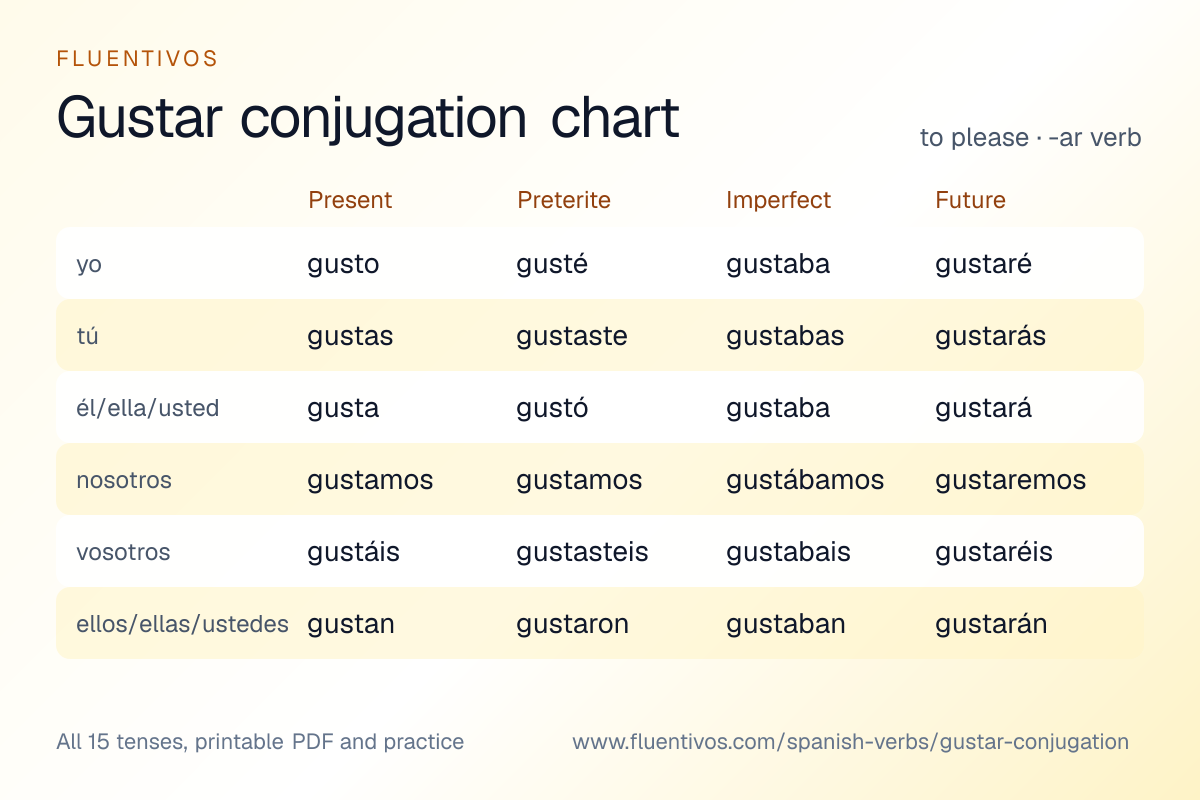
gustar follows the standard -ar endings in its core simple forms. Match each ending to the subject pronoun, and pay attention to the auxiliary haber in perfect forms.
These tables cover all 15 tenses and moods available in Fluentivos, with a separate conjugated form for each person, plus two everyday constructions: the present continuous (estar + gerund) and the near future (ir a + infinitive). A dash marks a form that does not exist, such as the first-person singular imperative.
The English column is a guide, not a word-for-word rule. Él/ella/usted is shown as he/she, with formal “you” added where the English verb changes, and ellos/ellas/ustedes as they.
Because gustar means “to be pleasing,” the English column shows the literal meaning (“pleases”). Me gusta el café is literally “coffee pleases me,” and in real conversation you will mostly meet the third-person forms gusta and gustan.
| Person | Form | English |
|---|---|---|
| yo | gusto | I please |
| tú | gustas | you please |
| él / ella / usted | gusta | he/she/it pleases; you (formal) please |
| nosotros | gustamos | we please |
| vosotros | gustáis | you all please |
| ellos / ellas / ustedes | gustan | they please |
| Person | Form | English |
|---|---|---|
| yo | he gustado | I have pleased |
| tú | has gustado | you have pleased |
| él / ella / usted | ha gustado | he/she/it has pleased; you (formal) have pleased |
| nosotros | hemos gustado | we have pleased |
| vosotros | habéis gustado | you all have pleased |
| ellos / ellas / ustedes | han gustado | they have pleased |
| Person | Form | English |
|---|---|---|
| yo | gusté | I pleased |
| tú | gustaste | you pleased |
| él / ella / usted | gustó | he/she/it pleased |
| nosotros | gustamos | we pleased |
| vosotros | gustasteis | you all pleased |
| ellos / ellas / ustedes | gustaron | they pleased |
| Person | Form | English |
|---|---|---|
| yo | gustaba | I pleased / used to please |
| tú | gustabas | you pleased / used to please |
| él / ella / usted | gustaba | he/she/it pleased / used to please |
| nosotros | gustábamos | we pleased / used to please |
| vosotros | gustabais | you all pleased / used to please |
| ellos / ellas / ustedes | gustaban | they pleased / used to please |
| Person | Form | English |
|---|---|---|
| yo | había gustado | I had pleased |
| tú | habías gustado | you had pleased |
| él / ella / usted | había gustado | he/she/it had pleased |
| nosotros | habíamos gustado | we had pleased |
| vosotros | habíais gustado | you all had pleased |
| ellos / ellas / ustedes | habían gustado | they had pleased |
| Person | Form | English |
|---|---|---|
| yo | gustaré | I will please |
| tú | gustarás | you will please |
| él / ella / usted | gustará | he/she/it will please |
| nosotros | gustaremos | we will please |
| vosotros | gustaréis | you all will please |
| ellos / ellas / ustedes | gustarán | they will please |
| Person | Form | English |
|---|---|---|
| yo | habré gustado | I will have pleased |
| tú | habrás gustado | you will have pleased |
| él / ella / usted | habrá gustado | he/she/it will have pleased |
| nosotros | habremos gustado | we will have pleased |
| vosotros | habréis gustado | you all will have pleased |
| ellos / ellas / ustedes | habrán gustado | they will have pleased |
| Person | Form | English |
|---|---|---|
| yo | gustaría | I would please |
| tú | gustarías | you would please |
| él / ella / usted | gustaría | he/she/it would please |
| nosotros | gustaríamos | we would please |
| vosotros | gustaríais | you all would please |
| ellos / ellas / ustedes | gustarían | they would please |
| Person | Form | English |
|---|---|---|
| yo | habría gustado | I would have pleased |
| tú | habrías gustado | you would have pleased |
| él / ella / usted | habría gustado | he/she/it would have pleased |
| nosotros | habríamos gustado | we would have pleased |
| vosotros | habríais gustado | you all would have pleased |
| ellos / ellas / ustedes | habrían gustado | they would have pleased |
| Person | Form | English |
|---|---|---|
| yo | guste | (that) I please |
| tú | gustes | (that) you please |
| él / ella / usted | guste | (that) he/she/it please |
| nosotros | gustemos | (that) we please |
| vosotros | gustéis | (that) you all please |
| ellos / ellas / ustedes | gusten | (that) they please |
| Person | Form | English |
|---|---|---|
| yo | haya gustado | (that) I have pleased |
| tú | hayas gustado | (that) you have pleased |
| él / ella / usted | haya gustado | (that) he/she/it have pleased |
| nosotros | hayamos gustado | (that) we have pleased |
| vosotros | hayáis gustado | (that) you all have pleased |
| ellos / ellas / ustedes | hayan gustado | (that) they have pleased |
| Person | Form | English |
|---|---|---|
| yo | gustara | (if) I pleased |
| tú | gustaras | (if) you pleased |
| él / ella / usted | gustara | (if) he/she/it pleased |
| nosotros | gustáramos | (if) we pleased |
| vosotros | gustarais | (if) you all pleased |
| ellos / ellas / ustedes | gustaran | (if) they pleased |
| Person | Form | English |
|---|---|---|
| yo | hubiera gustado | (if) I had pleased |
| tú | hubieras gustado | (if) you had pleased |
| él / ella / usted | hubiera gustado | (if) he/she/it had pleased |
| nosotros | hubiéramos gustado | (if) we had pleased |
| vosotros | hubierais gustado | (if) you all had pleased |
| ellos / ellas / ustedes | hubieran gustado | (if) they had pleased |
| Person | Form | English |
|---|---|---|
| yo | — | — |
| tú | gusta | please! |
| él / ella / usted | guste | please! (formal) |
| nosotros | gustemos | let's please! |
| vosotros | gustad | please! (you all, Spain) |
| ellos / ellas / ustedes | gusten | please! (you all) |
| Person | Form | English |
|---|---|---|
| yo | — | — |
| tú | no gustes | don't please! |
| él / ella / usted | no guste | don't please! (formal) |
| nosotros | no gustemos | let's not please! |
| vosotros | no gustéis | don't please! (you all, Spain) |
| ellos / ellas / ustedes | no gusten | don't please! (you all) |
estar + gerund
| Person | Form | English |
|---|---|---|
| yo | estoy gustando | I am pleasing |
| tú | estás gustando | you are pleasing |
| él / ella / usted | está gustando | he/she/it is pleasing; you (formal) are pleasing |
| nosotros | estamos gustando | we are pleasing |
| vosotros | estáis gustando | you all are pleasing |
| ellos / ellas / ustedes | están gustando | they are pleasing |
ir a + infinitive
| Person | Form | English |
|---|---|---|
| yo | voy a gustar | I am going to please |
| tú | vas a gustar | you are going to please |
| él / ella / usted | va a gustar | he/she/it is going to please; you (formal) are going to please |
| nosotros | vamos a gustar | we are going to please |
| vosotros | vais a gustar | you all are going to please |
| ellos / ellas / ustedes | van a gustar | they are going to please |
me gusta + infinitive
I like to do something
Me gusta cocinar los domingos. — I like cooking on Sundays.
me gustaría
I would like
Me gustaría reservar una mesa. — I would like to book a table.
no me gusta nada
I don't like it at all
No me gusta nada el invierno. — I don't like winter at all.
a mí también
me too (a mí tampoco: me neither)
—Me gusta el jazz. —A mí también. — —I like jazz. —Me too.
como gustes
as you like
Hazlo como gustes. — Do it as you like.
Spanish has separate verbs for liking something, loving something and wanting something.
To like. The thing liked is the subject.
Me gusta este libro.
I like this book.
To love or really like something. It works like gustar but is stronger.
Me encanta este libro.
I love this book.
To want something, or to love a person. The person is the subject.
Quiero este libro.
I want this book.
Use gustar and encantar for things you like, and querer when you want something or love a person.
Gustar means “to like,” but it works backwards from English: the thing you like is the subject, and you are the indirect object. Me gusta la música literally means “music is pleasing to me.”
The verb agrees with what is liked, not with who likes it: Me gusta el queso (singular) but Me gustan los quesos (plural). With an infinitive, always use the singular: Me gusta bailar.
Use an indirect object pronoun before gustar: me, te, le, nos, os, les. Add a and the person for emphasis or clarity: A Marta le gusta nadar and A mí me gusta nadar.
Yes. Me gusta Ana can mean “I like Ana” or “I'm attracted to Ana,” depending on context. To say you like someone as a friend, Spanish often uses caer bien: Ana me cae bien.